PCR PP: A Buyer's Guide to Post-Consumer Recycled PP Pellets
PCR PP (post-consumer recycled polypropylene) is polypropylene resin recovered from plastic waste that end consumers have already discarded, then reprocessed into new pellets. The waste is sorted, shredded, washed, dried, melt-filtered and pelletized, and the polymer keeps its basic chemical structure through the process. In trade language, PCR PP is a subset of recycled polypropylene, usually written rPP: all PCR PP is rPP, but rPP also covers post-industrial scrap that never reached a consumer.
That distinction matters at the purchasing stage. Post-consumer feedstock has passed through households, collection systems and material recovery facilities, so it carries more variation in melt flow, colour, odour and contamination than factory scrap does. That variation is what buyers are really evaluating when they compare PCR PP suppliers, and it is why two quotations for the same nominal resin can describe two different materials.
This guide is written for the awareness and research stage of that decision. It explains what PCR PP is, where specification failures come from, how grade families differ by melt flow index and application, which certification evidence answers which compliance question, and how a virgin-to-PCR conversion is validated before mass production. It also uses re-mall PCRPP, the PCR polypropylene line of Shanghai Re-mall Environmental Protection New Material Co., Ltd., as a documented reference case.
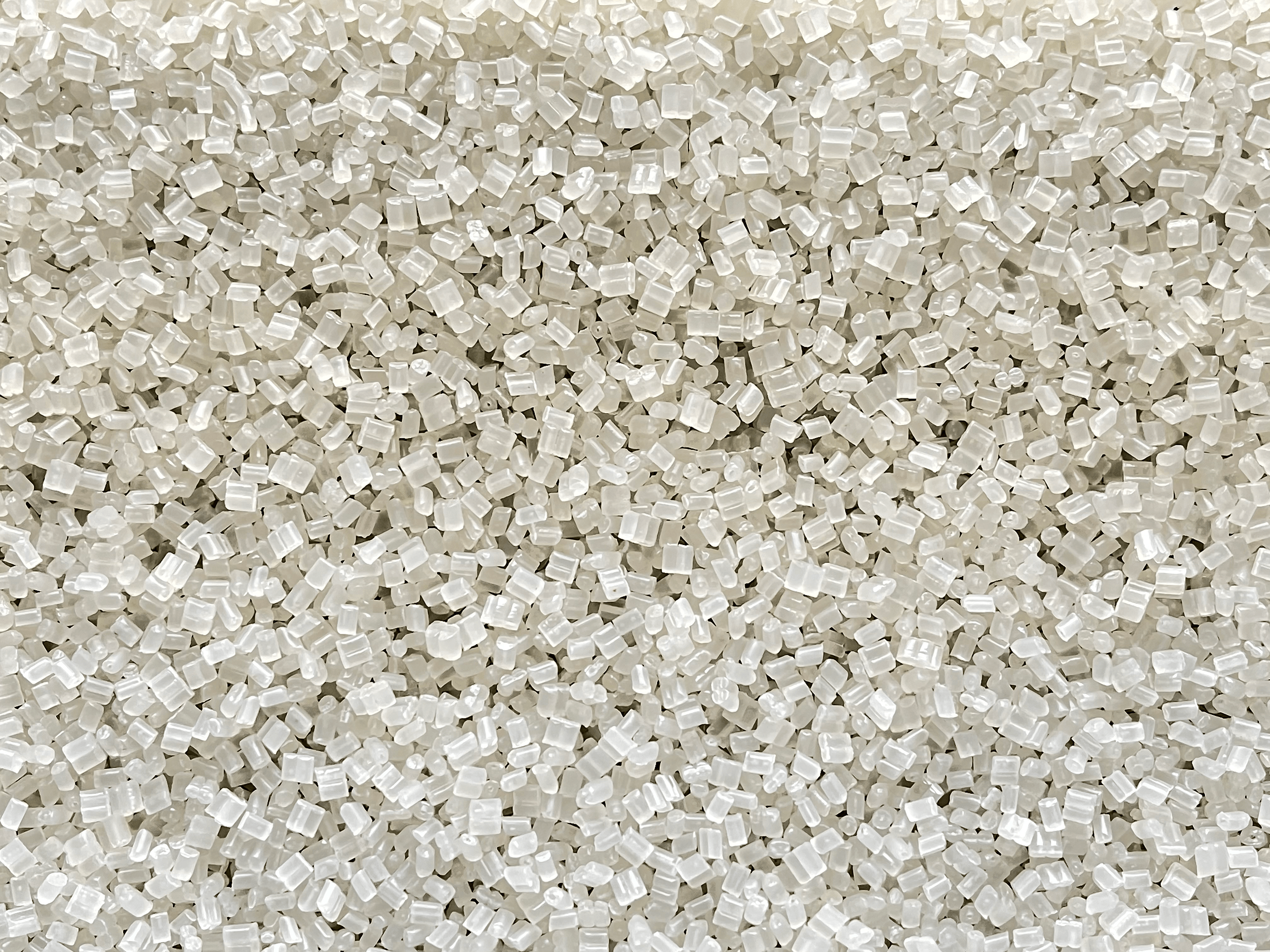
Cover: re-mall PCRPP multi-purpose PCR PP recycled pellet (grade PP-TC310-TR).
Why PCR PP Is Harder to Buy Than Virgin PP
Virgin PP is bought against a datasheet that rarely moves. PCR PP is bought against a datasheet plus a feedstock history. Three failure modes account for most of the gap between a successful conversion and a rejected batch, and none of them is visible in a price per kilogram.
1. Process instability
Melt flow drift, black specks, gels and rising filtration pressure appear on the production line rather than on the certificate. They originate in mixed feedstock, incomplete sorting and inconsistent drying. A converter running thin-wall packaging or fine-denier spinning feels them first, because both processes tolerate a narrow melt flow window.
2. Sensory performance
Odour comes from residues that were never fully removed. Colour difference shows up in natural and light shades and on high-gloss cosmetic surfaces, where a small shift reads as a quality defect to the end consumer. For household products, toys and personal-care packaging, sensory performance often decides whether a PCR PP grade is usable at all, long before mechanical properties are discussed.
3. Compliance ambiguity
A supplier may describe material as food grade without a submission record that names the recycling process, the feedstock origin and the conditions of use. Under the US FDA recycled plastics review, eligibility is tied to exactly those details, and different submissions carry different conditions. A general food-contact claim and a documented one are not the same evidence.
The practical consequence is that the buying question is not which PCR PP is cheapest. It is which grade, matched to which application, supported by which evidence. Answering that question requires grade-specific data, process documentation and validation batches rather than a broader supplier promise.
Industry Background: Where Post-Consumer Recycled PP Stands in 2026
Demand for recycled polyolefins is being pulled by regulation, brand recycled-content targets and Scope 3 accounting. As a scale indicator, Fortune Business Insights values the global PCR plastic packaging market at USD 58.49 billion in 2026 and projects USD 108.27 billion by 2034. That figure covers PCR plastic packaging as a whole rather than polypropylene alone, so it signals direction and investment weight rather than a PP-specific volume.
The environmental case is also the commercial case for many buyers. Industry analysis summarised alongside that market data puts the carbon reduction from using PCR at approximately 60% compared with virgin material. That is the kind of figure a brand can carry into a Scope 3 inventory, but only if the material is traceable and the claim is documented rather than asserted.
Supply is expanding faster than documentation standards. Producers range from operations regranulating mixed bales to integrated plants with in-house sorting, washing, filtration and laboratory testing. The difference is visible less in marketing language than in paperwork: batch test records, certificate numbers, regulatory submission identifiers and traceability from source to pellet.
Regulators have tightened what counts as acceptable evidence rather than redefining the polymer. For food contact in the US market, a recycling process is assessed through the FDA recycled plastics review, and the resulting no-objection letter describes which feedstock, which process and which conditions of use are covered. That is a narrower and more useful claim than food grade, and it is the claim a brand compliance team will ask to see.
What a Qualified PCR PP Supply Should Include
Shanghai Re-mall Environmental Protection New Material Co., Ltd. (re-mall) is a Shanghai-based recycler and recycled-material producer founded in 2015 that integrates recycling, research and development, manufacturing, sales and application support, and supplies recycled plastic pellets including PCR-PP, PCR-PE, PCR-PS and PCR-ABS. Its PCR polypropylene range is supplied as re-mall PCRPP, with grade families separated by melt flow index, application and certification scope rather than by resin name alone.
The company operates a 10,000 square metre facility with more than 100 employees and an annual output of 20,000 metric tons, and reports a 22-engineer R&D team, more than 100 patents across the group and its subsidiaries, and a recycled plastics laboratory accredited by CNAS through its wholly-owned subsidiary Shanghai Re-poly Environmental Technology Co., Ltd. Around 30% of output is exported, with main markets in Europe, Japan, Southeast Asia, South Asia and North America.
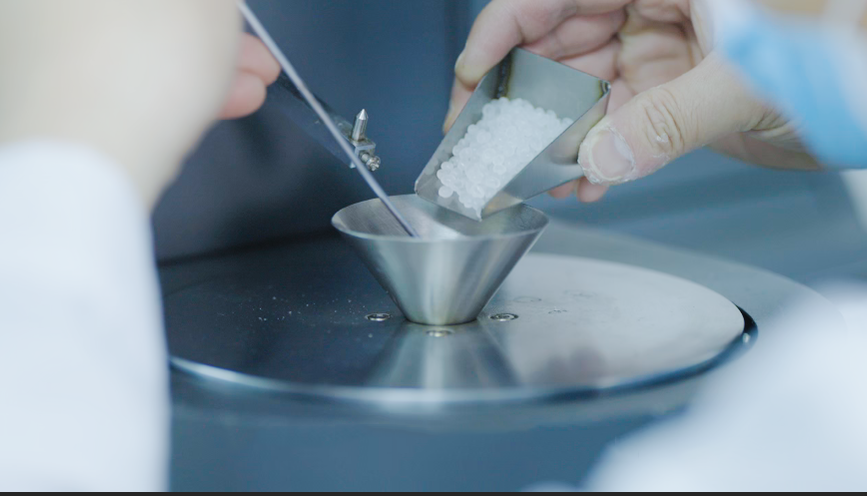
Batch testing and material evaluation are part of the PCR PP grade-matching process.
Grade families and melt flow index
Melt flow index (MFI) is the first filter in grade selection, because it decides whether a material can be moulded, extruded or spun on existing equipment. re-mall PCRPP covers a broad MFI window across families:
- Multi-purpose PCR PP, supplied as three discrete grades: PCR-PP310 at 55 g/10 min, PCR-PP301 at 30 g/10 min and PCR-PP392 at 10 g/10 min.
- General-purpose recycled materials, with PCR PP from 1 to 40 g/10 min, aimed at cost-driven daily necessities, home appliances and general injection-moulded or blow-moulded parts.
- Food-contact grade PCR PP from 3 to 70 g/10 min, for food containers, beverage containers and kitchenware.
- Safety-focused PCR PP from 5 to 70 g/10 min, for daily chemical packaging, food-contact materials, toys and office stationery.
- Appearance-focused PCR PP from 5 to 50 g/10 min, for daily chemical packaging, homeware, storage and organization, and decor.
- Fiber-grade PCR PP from 5 to 60 g/10 min, for carpets, home textiles, apparel, nonwoven fabrics, woven fabrics and outdoor gear.
Splitting the portfolio this way lets a converter select by process and end use instead of adjusting the whole line around a single number. For stiffness-driven parts, the high modulus PCR-PP grade is specified above 1800 MPa flexural modulus with PCR content of 30% to 50%.
Purity, odour and colour: the three failure points
High-purity, low-odour and high-transparency grades are engineering outcomes, not adjectives. Odour is controlled at multiple stages, including raw material source control, washing, drying, melt filtration, devolatilization and formula optimization, rather than through end-point deodorization alone. Colour consistency is handled through raw material colour sorting, colour matching management, raw material homogenization and production-process control.
Purity for food-contact and fibre work starts with feedstock. The food-contact range is sourced from post-consumer food packaging waste and processed on an in-house food-grade recycling line, with feedstock purity above 98% and lower contamination. For fibre spinning, the requirement is a cleaner material that keeps spinning and web formation stable across a run.
Batch consistency and traceability
Batch consistency is the output of a chain, not a single step: raw material source control, fine sorting, deep washing, high-efficiency filtration, compounding and pelletizing, batch testing, and data traceability. Traceable PCR PP means a buyer can follow a pellet lot back through those stages. It is also the precondition for any recycled-content statement that survives an audit.
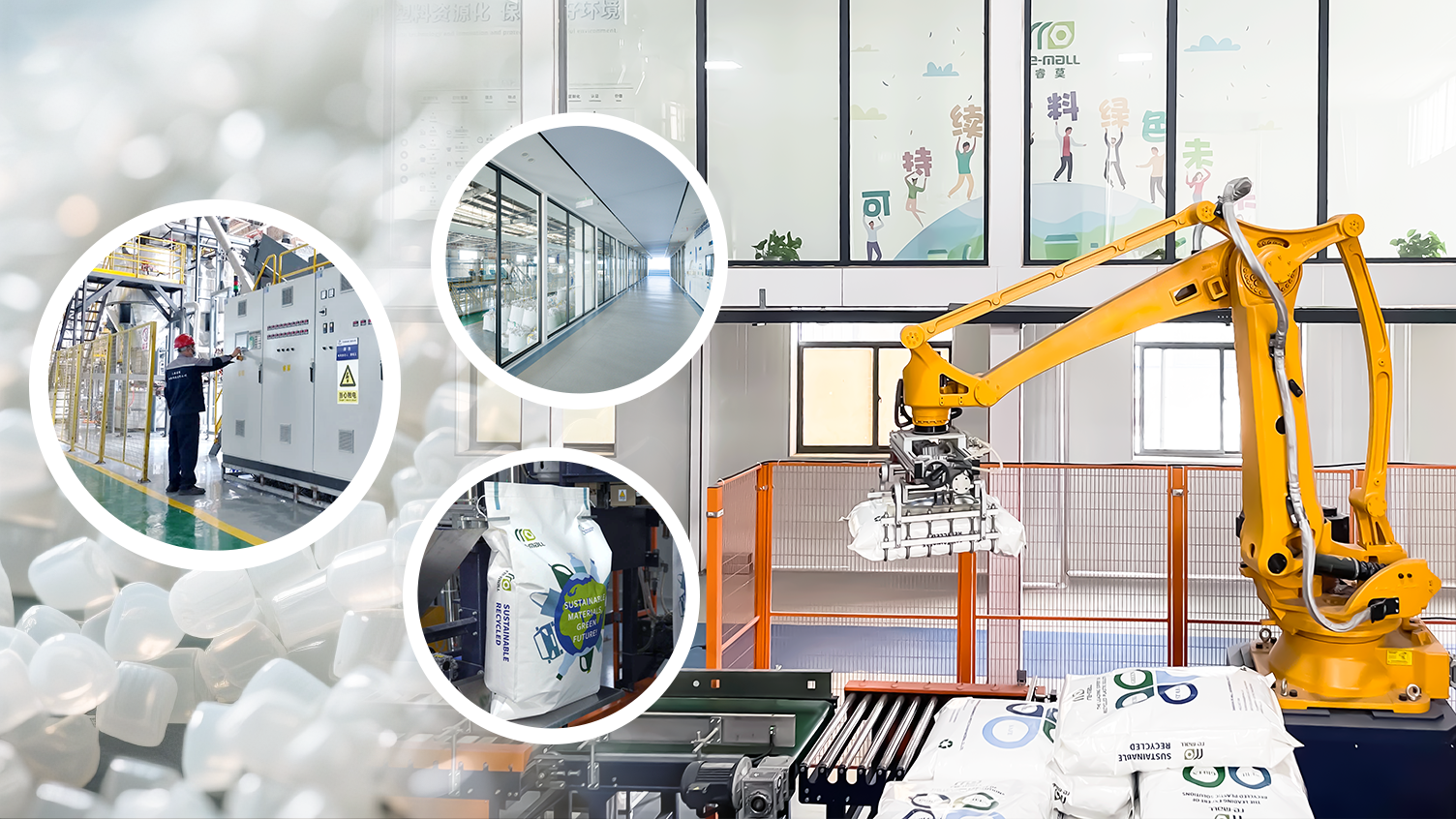
Digital production management supports batch records and traceability for re-mall PCRPP.
Certification and regulatory evidence
re-mall products and production lines hold an FDA Letter of No Objection (NOL), Global Recycled Standard (GRS) certification, ISO 14021 verification, Ocean Bound Plastic (OBP) certification and ISO 14067 product carbon footprint certification. Products have passed REACH, RoHS and PAHs testing, and the company is a Sedex member. The FDA record is specific: NOL PNC 396, dated 6 June 2025, covers the physical recycling of PP cups into articles in contact with all food types under Conditions of Use E through G.
The limits matter as much as the claims. A no-objection letter covers a defined feedstock and process, not every grade in a portfolio. A GRS certificate addresses recycled content and chain of custody, not food-contact suitability. A carbon footprint certification quantifies a footprint; it does not make it zero. Buyers who read each document for the question it answers avoid most specification disputes later.
| Document | Question it answers |
|---|---|
| FDA Letter of No Objection | Whether a defined recycling process and feedstock are acceptable for stated food-contact conditions of use |
| GRS certification | Recycled content and chain of custody of the recycled material |
| ISO 14021 verification | Whether a self-declared environmental claim has been verified |
| ISO 14067 certification | The quantified product carbon footprint of the material |
| REACH, RoHS and PAHs testing | Whether restricted substances are below the tested limits |
| OBP certification | Whether the feedstock is certified ocean-bound plastic |
Step-by-Step: Switching a Product Line from Virgin PP to PCR PP
A conversion is a validation project, not a purchase order. The documented re-mall approach runs in seven stages, and the logic is gradual substitution: prove the material on the real tool, then raise the recycled proportion.
- Raw material analysis. The buyer brings the current virgin grade, its datasheet and the part or fabric being made.
- Application requirement confirmation. Performance, appearance, regulatory and processing requirements are fixed before any resin is proposed.
- PCR material matching. Grades are matched on processing technology, MFR, rigidity, impact performance, colour, PCR content and certification requirements.
- Virgin and PCR ratio design. The recycled proportion is set as a target rather than assumed, so the first trial has a defined baseline.
- Sample testing. Mechanical, aesthetic and processing behaviour is checked on specimens or trial parts.
- Pilot production verification. The grade runs on the actual line, where melt stability, odour and colour are judged in real conditions.
- Mass rollout. Batch records, certificates and traceability documentation are locked in for routine supply.
Two screens that decide the grade
The performance screen covers tensile strength, impact strength, rigidity, flexural modulus, elongation at break, heat deflection temperature, dimensional stability and chemical resistance. The aesthetic screen covers colour, colour difference, black specks, impurities, surface gloss, odour and colour matching capability. A grade that passes the first screen and fails the second is still unusable for consumer-facing parts, which is why both screens belong in the same evaluation rather than in sequence.
Use Cases: Where PCR PP Fits
Packaging and food contact
Food containers, beverage containers and kitchenware are the most tightly documented application. The requirement is not simply a food-contact grade but a grade whose recycling process and feedstock are covered by a submission, with conditions of use that match the intended filling, storage and reheating profile.
Daily chemical packaging and household products
Bottles for personal care and household liquids typically need a translucent material that is easy to colour, can reach a high-gloss finish, keeps black specks low and stays safe in direct contact with the product. Homeware, storage and organization products place the emphasis on appearance and stiffness instead, which is where appearance-focused grades with higher transparency and modulus are used.
Toys
Toys combine food-contact-level safety expectations with colour and odour sensitivity, because the product is handled closely and often brightly coloured. Low odour, consistent colour and validated safety documentation are the deciding criteria, and both PCR PP and PCR ABS are used depending on whether the part is a shell, a structural component or a decorative element.
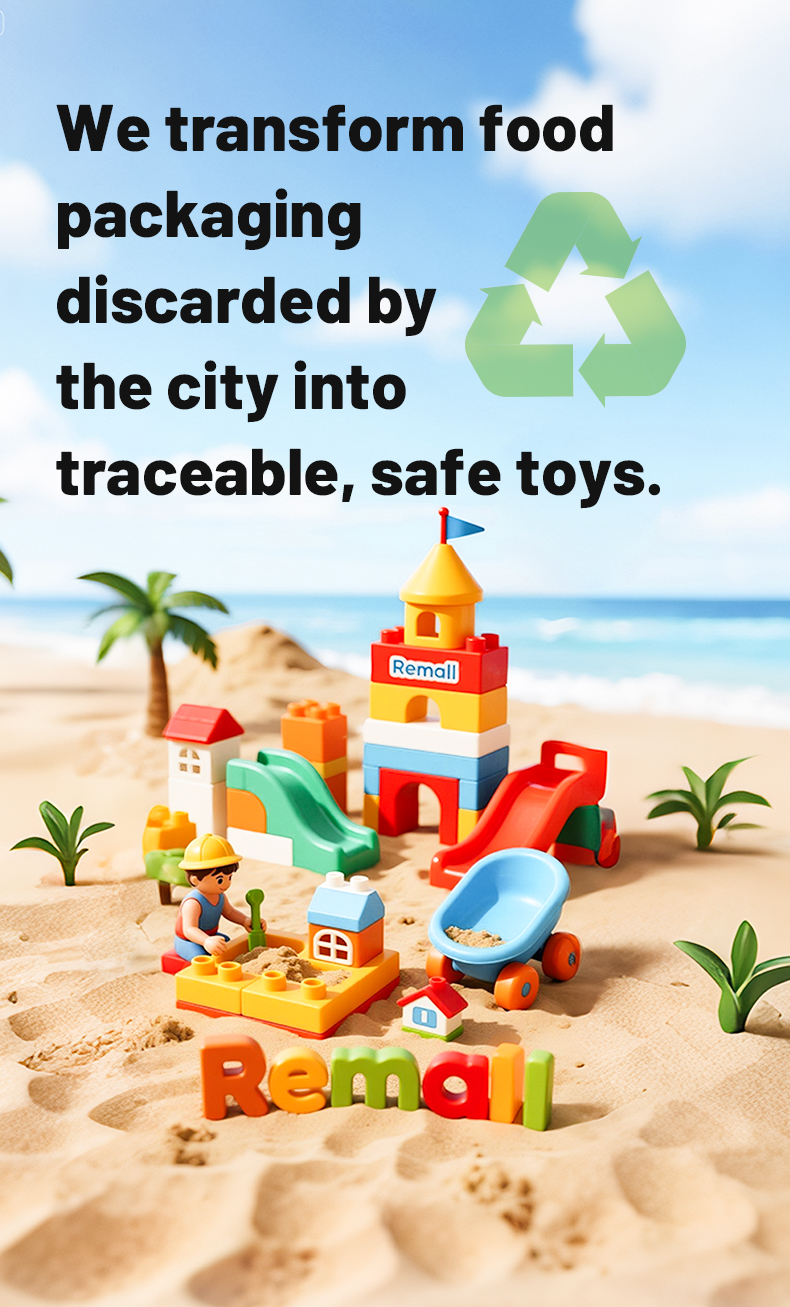
Toys require low odour, stable colour and documented safety performance.
Nonwoven fabric, fibre and textiles
Fiber-grade PCR PP serves staple fibre, yarn, carpet, home textile, apparel and nonwoven fabric, including shopping bags and storage bags where the fabric must be water-resistant, breathable, lightweight and tear-resistant. The technical demand is consistent melt flow and low impurity content, because both spinning and web formation amplify small variations.
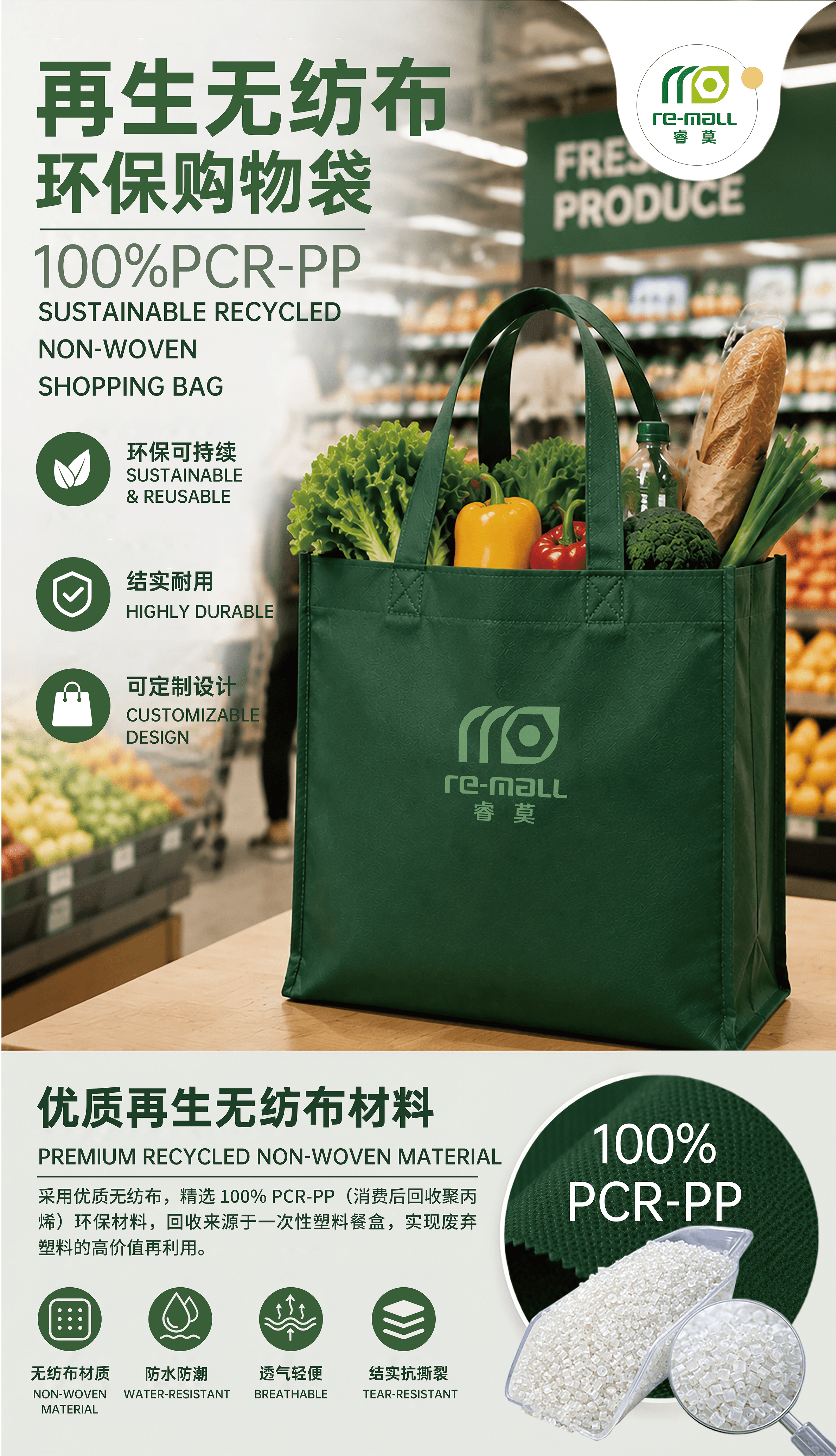
Fiber-grade PCR PP supports nonwoven and woven fabric applications.
Office stationery and general moulded goods
Stationery and general injection-moulded parts tolerate a wider performance band and are usually driven by cost and colour consistency. General-purpose and multi-purpose PCR PP grades are the natural starting point, with the recycled proportion set by the brand target rather than by the process limit.
Comparison: Grade Families and Regulatory Scope
re-mall PCRPP grade families
| Grade family | PCR-PP melt flow index | Intended applications |
|---|---|---|
| Multi-purpose (PCR-PP310, PCR-PP301, PCR-PP392) | 55 / 30 / 10 g/10 min | Packaging, household and consumer goods, textiles and nonwovens, toys, office stationery |
| General-purpose | 1 to 40 g/10 min | Daily necessities, home appliances, general injection-moulded and blow-moulded parts |
| Food-contact | 3 to 70 g/10 min | Food containers, beverage containers, kitchenware |
| Safety-focused | 5 to 70 g/10 min | Daily chemical packaging, food-contact materials, toys, office stationery |
| Appearance-focused | 5 to 50 g/10 min | Daily chemical packaging, homeware, storage and organization, decor |
| Fiber-grade | 5 to 60 g/10 min | Carpets, home textiles, apparel, storage, nonwoven and woven fabrics, outdoor gear |
How FDA recycled-PP submissions differ in scope
| Company and submission date | Conditions of use listed | Stated basis or limitation |
|---|---|---|
| Shanghai Re-mall, NOL PNC 396, 6 June 2025 | All food types, Conditions of Use E through G | Physical recycling of PP cups into food-contact articles |
| PureCycle Technologies, 10 July 2025 | All food types, Conditions of Use A through H | Up to 37% recycled content, subject to stated conditions |
| Kingfa Sci and Tech., 1 November 2023 | All food types, Conditions of Use C through G | PCR-PP from previously used food-contact articles |
These entries are not ranked. They illustrate a practical point: three submissions for the same polymer carry three different sets of conditions, feedstock requirements and recycled-content limits. A buyer comparing them is comparing regulatory scope, not supplier quality, and should match the scope against the actual filling, storage and use conditions of the package.
Frequently Asked Questions
Is re-mall PCRPP compliant for food-contact use?
re-mall holds FDA Letter of No Objection PNC 396, dated 6 June 2025, covering the physical recycling of PP cups into articles in contact with all food types under Conditions of Use E through G. Products and production lines also hold FDA NOL, GRS certification, ISO 14021 verification, OBP certification and ISO 14067 product carbon footprint certification, and products have passed REACH, RoHS and PAHs testing. Food-contact eligibility remains grade- and use-condition-specific, so the exact grade, feedstock and intended conditions of use should be checked against the submission record before the material is specified.
What PCR PP grades can re-mall supply, and how is the right one chosen?
re-mall PCRPP covers multi-purpose grades PCR-PP310 at 55 g/10 min, PCR-PP301 at 30 g/10 min and PCR-PP392 at 10 g/10 min, plus general-purpose PCR PP from 1 to 40 g/10 min, food-contact PCR PP from 3 to 70 g/10 min, safety-focused PCR PP from 5 to 70 g/10 min, appearance-focused PCR PP from 5 to 50 g/10 min and fiber-grade PCR PP from 5 to 60 g/10 min. Selection starts from the processing method and MFI window, then narrows on mechanical performance such as impact, rigidity and flexural modulus, appearance criteria such as colour, black specks, gloss and odour, and finally on certification requirements and PCR content. Final confirmation comes from sample testing and pilot production rather than from a datasheet alone.
What drives the cost of PCR PP compared with virgin PP?
Cost follows the specification rather than the resin name. Two orders for PCR PP can differ in feedstock quality and sorting intensity, MFR band, PCR content, colour and odour requirement, certification scope and volume, and each of those changes the material that is actually delivered. Because of this, PCR PP is quoted per grade and per specification, and a single list price is not a meaningful comparison. Buyers should request a quotation that states target MFI, application, PCR content and required certificates, and should compare total cost including reject rates and validation time instead of price per kilogram alone.
How are samples and pilot validation handled?
Material is matched to the buyer's processing technology, MFR, rigidity, impact performance, colour, PCR content and certification requirements, and the match is then validated through sample testing and pilot production. The full sequence runs from raw material analysis and application requirement confirmation through PCR material matching, virgin and PCR ratio design, sample testing, pilot production verification and finally mass rollout. Samples are therefore a step inside the qualification process, and the trial result on the real tool is what confirms the grade.
How should buyers shortlist China PCR PP pellet manufacturers, and what affects lead time?
Shortlisting should rest on verifiable items: the legal entity and production site, a named regulatory submission or certificate number, batch test records, a laboratory with recognised accreditation and traceability from feedstock to pellet. As a reference point, re-mall was founded in 2015, operates a 10,000 square metre facility with more than 100 employees and 20,000 metric tons of annual output, reports a 22-engineer R&D team and a CNAS-accredited recycled plastics laboratory through Shanghai Re-poly, holds more than 100 patents across the group and its subsidiaries, and has participated through its subsidiaries in the formulation of 9 national standards and 1 industry standard. Lead time depends on grade, quantity and certification scope, so it is confirmed at quotation stage together with the delivery schedule. To start, request a sample or quotation at info@re-mall.cn or +86 152-2184-1874 on WhatsApp.
Conclusion: Choose the Grade and the Evidence, Not the Resin Name
PCR PP is a category, not a specification. The material that works in a cosmetic bottle, a toy shell, a nonwoven shopping bag and a food container differs in melt flow, purity, odour, colour and regulatory scope, even when all four are described as recycled polypropylene. Buyers who treat the resin name as the answer tend to discover the difference during the first production run.
A workable evaluation therefore has four parts: an MFI and application match, a sensory screen covering odour and colour, a batch and traceability chain that survives audit, and a compliance document that answers the exact question being asked. re-mall PCRPP is structured around those four parts, from grade families separated by melt flow and application through multi-stage odour control, colour management, CNAS-accredited laboratory testing, FDA NOL PNC 396, GRS, ISO 14021, OBP and ISO 14067 certification. Since 2015 the company reports cumulative recycling of more than 300,000 tons of plastic and a carbon emission reduction of more than 500,000 tons.
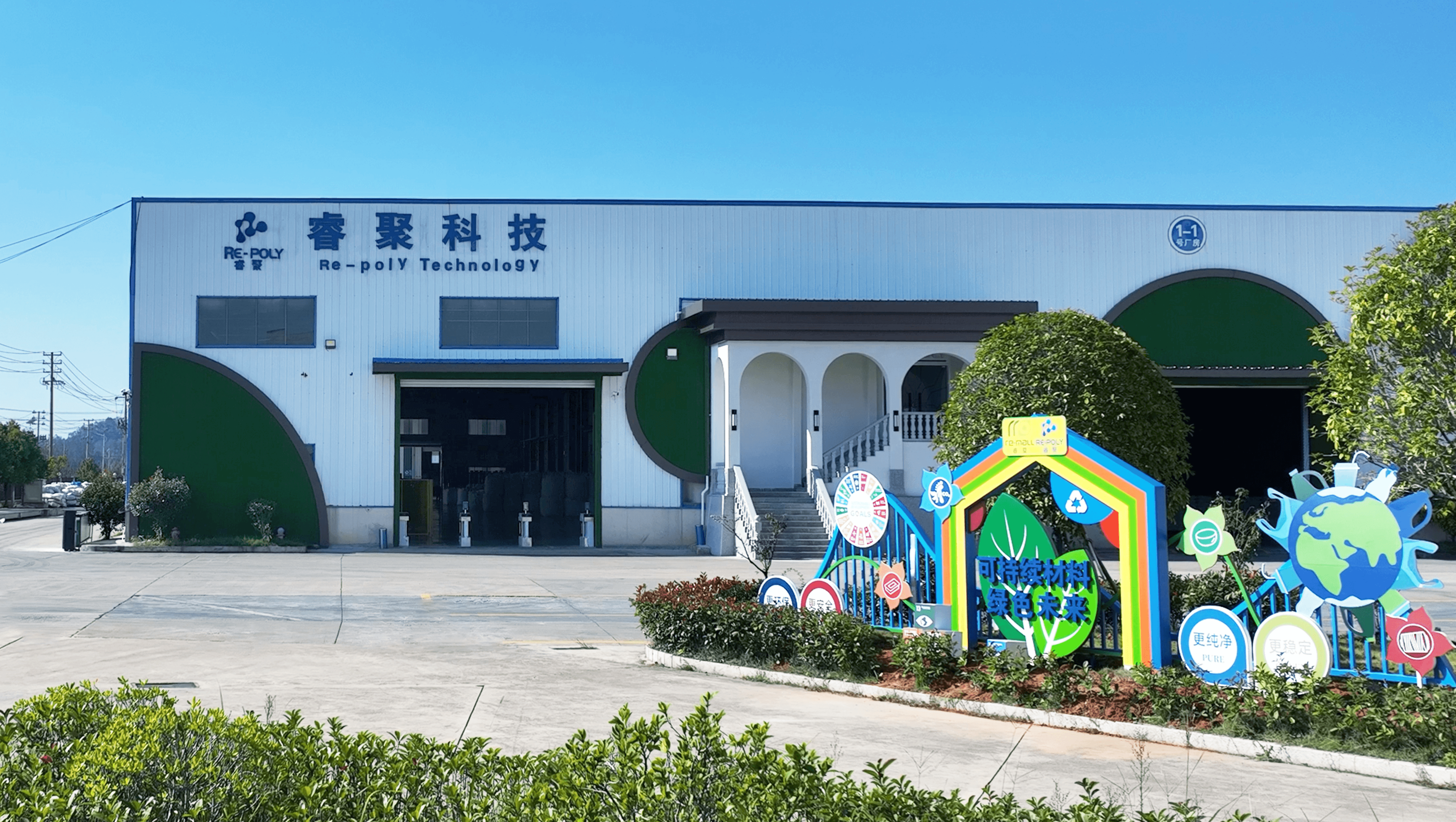
Sample requests and grade matching begin with the application and the target MFI.
Next step: match a re-mall PCRPP grade to your part
Send the current virgin grade, the target MFI, the application and the certification you need. You will receive a grade recommendation, a sample arrangement and a quotation for the matched specification.
- Sample and pilot validation: info@re-mall.cn
- WhatsApp: +86 152-2184-1874
- Tel: +86 400-175-0224
- Website: https://remall-repoly.com
Company brochure (PDF, open access): download the re-mall company brochure.
Source notes: market size and carbon reduction figures are reported by Fortune Business Insights (PCR plastic packaging market, 2026 to 2034). FDA submission details are drawn from the FDA recycled plastics database, including NOL PNC 396 (6 June 2025), the PureCycle Technologies entry dated 10 July 2025 and the Kingfa Sci and Tech. entry dated 1 November 2023. Company, product and certification facts are as stated by Shanghai Re-mall Environmental Protection New Material Co., Ltd.
Have Questions or Need More Details?
Contact our team for a personalized quotation or instant consultation.
Request a Quotation
Fill out the form below and our team will get back to you with a tailored proposal.
WhatsApp Direct Chat
Prefer to chat in real-time? Message us on WhatsApp for instant assistance & quick answers.
- Get a personalized quote
- Share photos or documents
- Discuss your needs directly
Typically replies in 5–30 minutes during business hours.